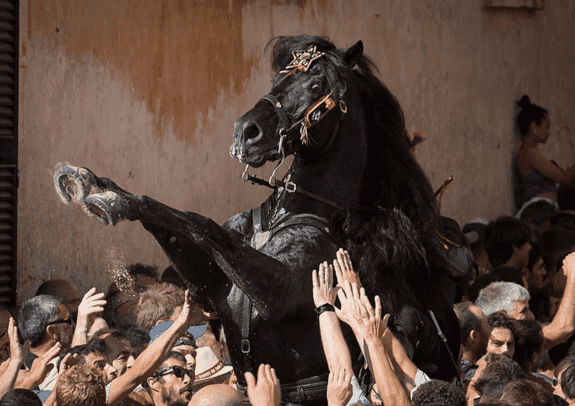
The Sant Joan festivities, held in the city of Ciutadella, Menorca, are one of the island’s most iconic and eagerly awaited events on the festive calendar. This celebration, held every year from June 23 to 24, has deep roots and a tradition spanning centuries, combining religious rituals, local customs, and an atmosphere that draws both residents and visitors. Learn more about this festival in this IsasMenorca article.
Origins and tradition
The origin of the Sant Joan festivities in Ciutadella dates back to medieval times. Although the religious celebration is the foundation of these festivities, over the years Menorca’s celebrations have taken on a range of traditions that include not only liturgical acts but also pagan elements reflecting the island’s cultural syncretism. Over the centuries, the festival has evolved into a spectacular event that attracts thousands of people from all over the world.
In its early days, the festivities had a purely religious character, dedicated to honoring Saint John the Baptist, whose feast day falls on June 24. However, the influence of popular customs—such as music, dance, and outdoor rituals—began to be woven into the celebrations, turning the festivities into a unique blend of the sacred and the secular.
Horses: The stars of the festival
One of the most distinctive features of the Sant Joan festivities is the presence of horses. During the festival days, horses become the undisputed stars. The streets of Ciutadella fill with Menorcan-breed horses, a symbol of the island, ridden by horsemen known as “caixers” (knights).
The most anticipated event of the festival is the “Jaleo”, a display of the riders’ skill and bravery as they ride through the town’s main squares, testing both the animals’ nerves and abilities. The riders perform acrobatics and quick maneuvers while crowds gather around them, clapping and cheering. The highlight of the Jaleo is when the horses stop right in the center of the square and the rider, standing upright on the animal, performs a series of gravity-defying movements—creating a rush of excitement and adrenaline among those watching.
In addition to the “caixers”, other people take part in the festival by leading the horses through the streets, creating an atmosphere of pure Menorcan tradition. These events highlight the special relationship the island’s residents have with horses—an essential part of Menorca’s culture and history.
A parade of colors and sounds
The celebration isn’t limited to equestrian events, as the festival includes a series of parades and processions that fill the streets of Ciutadella with music, dancing, and a riot of color. Sant Joan Day begins with a solemn Mass in honor of the saint, followed by a religious procession in which the image of Saint John the Baptist is carried through the streets of Ciutadella’s old town.
Local music groups, known as “bands” and “tabal and flute groups”, play traditional melodies while festival-goers gather in different groups, dressed in traditional costumes. The dances and folk performances blend with the music that accompanies every step of the route. All of this helps create a unique atmosphere that makes both children and adults feel part of a celebration that has been passed down through generations.